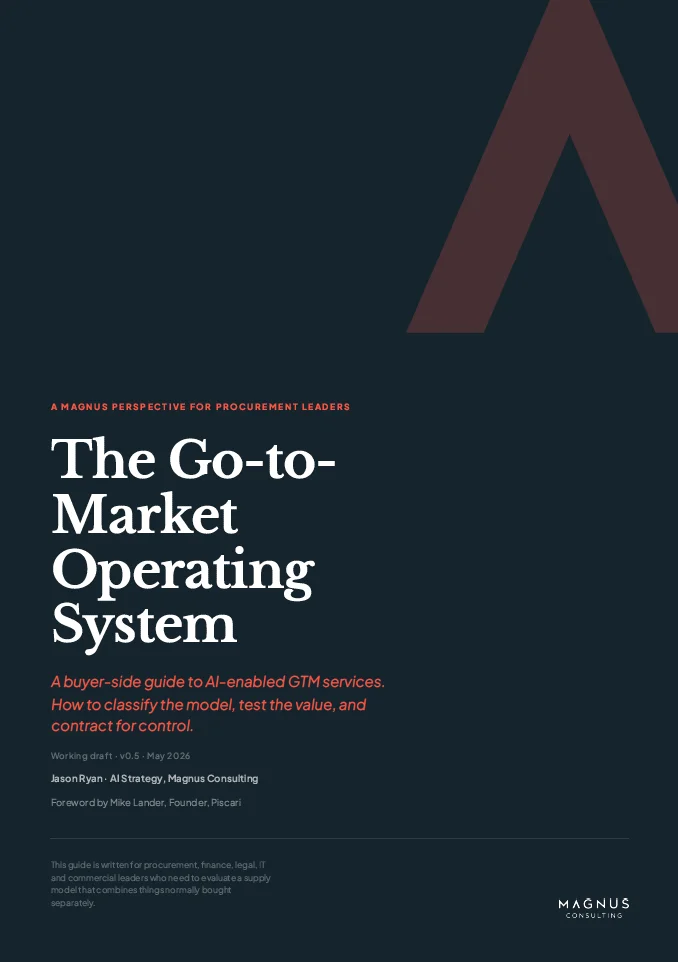
How to buy AI in B2B GTM. The buyer's guide to AI-powered GTM systems.
AI is reshaping the GTM supplier market. As strategy, data, workflows, automation and human judgement are bundled into new operating models, this guide helps B2B procurement leaders make sense of what is really being offered, buy for impact and stay in control.
Why this guide exists.
AI has not just made existing GTM services more efficient. It is changing the unit of value itself.
Suppliers are increasingly combining things that used to be bought, priced and governed separately: consultancy, software, data infrastructure, managed execution, AI-enabled automation and human judgement. That creates a different buying problem for commercial, procurement, finance, legal and IT teams.
The question is no longer simply whether a supplier can move faster with AI. It is what capability they are creating, where it lives, how value is evidenced, what the buyer owns and what happens if the supplier has to be replaced.
With a foreword from procurement and agency transformation expert Mike Lander, this guide gives buyers a practical way to test the AI story before it becomes the buying logic.
How to buy AI, the client edition.
A new guide from the Magnus team is in development. Register your interest to be the first to access it when it lands.
Sign up to be notified when it goes live.
What's Inside
What changed in the GTM supplier market
Procurement has seen disruption before: digital agencies, SaaS, cloud platforms, performance marketing, managed services and outsourced operations have all created classification and governance challenges.
What is different now is convergence inside a single engagement, and the speed at which it is arriving.
The clean distinction between consultancy, SaaS and managed service is becoming harder to apply. A single engagement can now include senior growth strategy, configured workflows, knowledge graphs, AI agents, CRM or marketing automation integration, content operations, signal detection, data visualisation, adoption support and ongoing governance.
Each component is familiar. The combination is what creates classification pressure.
Do we buy this at all?
Before classifying the supplier model, the more fundamental question is capability ownership. This is the make-versus-buy, own-versus-rent, control-point decision. Start with the constraint in the growth system and work through the questions that determine whether the capability should be bought, built, partnered for or avoided altogether:
What business problem are we solving?
Is this a source of sustainable competitive advantage?
Does it duplicate what we already have?
Where are the critical control points?
What will we stop, consolidate or replace?
What is the route out?
Walking away is not failure if the business problem is unclear, the supplier duplicates capability already in the organisation, the value cannot be measured, or the exit route is weak.
Classify the model
Once the capability ownership question is clear, buyers need to understand what kind of supplier model is in front of them.
The procurement question
The procurement question is not, "Has the supplier invented a new category?" The procurement question is, "What treatment does this buying situation require?"
Some AI-enabled GTM services look like consultancy, software or managed service. Others combine strategic and commercial judgement, embedded data and workflow infrastructure, AI-enabled automation, ongoing human governance, managed operation and measurable value accountability. The report uses a practical working label for this kind of model: Platform-Enabled Managed Service, or PEMS. The label matters less than the treatment. If the engagement creates operating dependency, shares value risk and raises material questions around IP, data, portability or exit, it needs to be bought and contracted differently.
A useful classification needs to survive three tests:
Does the engagement create an operating dependency?
What capability has been created, where does it live, who can operate it, and what degrades if the supplier stops?
Does the commercial model share value risk?
There needs to be a clear logic connecting price to outputs, adoption, service levels, usage, capability transfer and, where appropriate, a capped performance layer.
Are IP, data and portability clear?
If the supplier cannot explain what the client owns, what the client licenses, what can be exported and what happens on termination, the proposition is not yet ready for serious procurement scrutiny.
Evaluate: genuine or cosmetic
Most suppliers can describe a compelling AI story. The useful distinction is whether there is operating evidence underneath that story.
Two gateway questions help separate the narrative from the operating model.
Gateway question 1
What changes if we stop?
If the service was cancelled, what specifically would stop, degrade, become manual or lose freshness inside the business?
A strong supplier can answer in operational terms: named workflows, data feeds, dashboards, playbooks, automations, governance routines and decision processes. A weak supplier will talk mainly about access, reports or generic support.
Gateway question 2
Where does the infrastructure live?
Where do the data, workflows, configurations, agents and outputs live, and who can operate them?
If the answer is inside the supplier's environment only, the buyer is taking a different risk from a model built inside the client's environment.
Evidence is the separator, not language.
Commercial structures that work
Once the model is classified and the supplier is credible, the commercial structure needs to make the value proposition visible.
The common mistake is to negotiate an AI-enabled operating model as if the only question is day rate.
If the supplier claims to build capability, provide access, run operations, govern judgement and share value risk, the pricing model should show where each commitment sits.
A balanced structure often has three parts:
Fixed-fee strategy and build
Subscription or managed service fee
Optional capped performance layer
One PO can include all three, but each line should have its own obligations, acceptance criteria and termination logic.
How the full guide helps buyers
Decide whether to buy at all
Use the Buy, Build, Partner or Walk Away matrix to decide what should sit inside the business, what can be rented, what should be co-developed and when to stop.
Classify the supplier model
Use the classification lens to decide whether the engagement should be treated as consultancy, SaaS, managed service or a hybrid AI-enabled GTM model.
Test the unit of value
Use the purchase spectrum to understand whether you are buying hours, deliverables, outputs, retained capability or outcomes, and what that means for pricing, governance and risk.
Separate genuine from cosmetic AI
Use the gateway questions, evidence hierarchy and eight-dimension scorecard to test the operating evidence behind the supplier narrative.
Structure the commercials
Use the commercial structure decision matrix to compare fixed build, POC to subscription, subscription plus governance, capped performance band and gainshare.
Contract for control and exit
Use the contract checklist to clarify AI governance, data, IP, portability, performance, termination and off-ramp before the supplier becomes embedded.
Align the buying room
Use the stakeholder alignment one-pager to bring commercial, procurement, finance, legal, IT, RevOps and leadership teams around the same buying questions before sourcing begins.
Classify the model. Test the value. Contract for Control. Download the buyer-side guide now.
Enter your name and work email below and we'll give you instant access. No sales follow-up. Just the guide.
No sales follow-up. Unsubscribe any time.
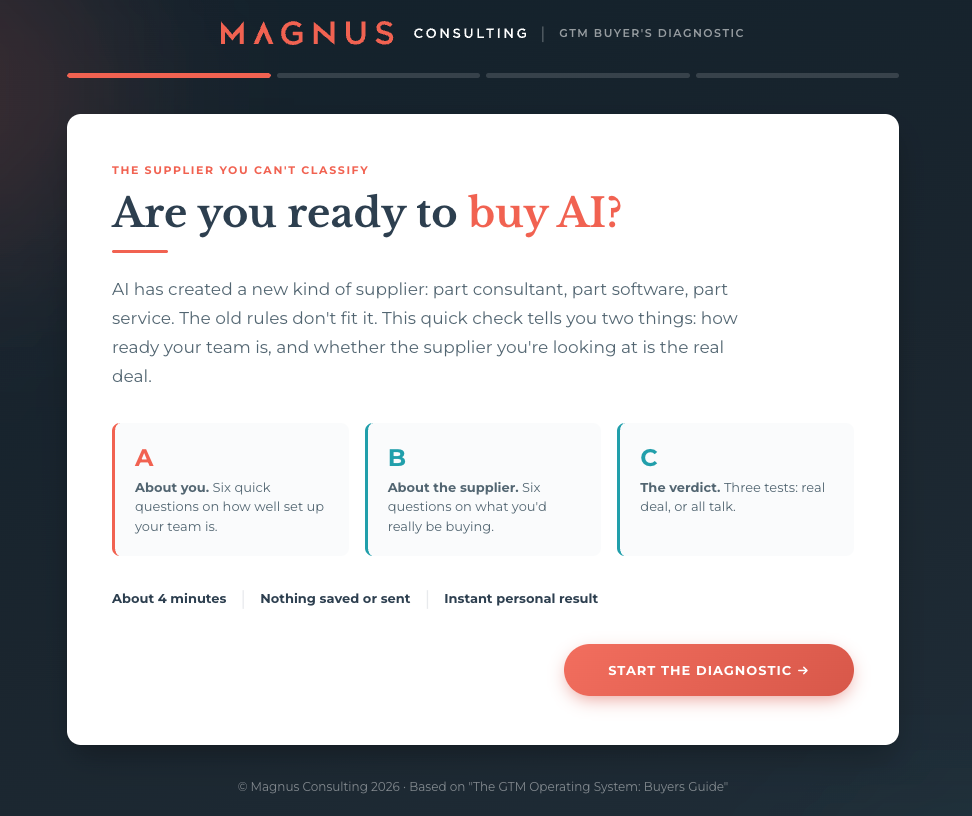
Know where you stand before you buy.
The guide gives you the framework for buying AI-powered GTM services. This diagnostic gives you your score when assessing the supplier. Answer 12 questions about your organisation and the supplier in front of you and get an instant readiness rating across three dimensions: strategic clarity, supplier credibility, and commercial control.